
SignalSense — Adaptive Traffic Signal Control That Thinks in Real Time
Fixed-time signals treat every hour the same. SignalSense doesn't — it reads live traffic demand at every approach and adjusts signal timing continuously, cutting delay and keeping corridors moving instead of running a schedule that was accurate yesterday.
The Challenge
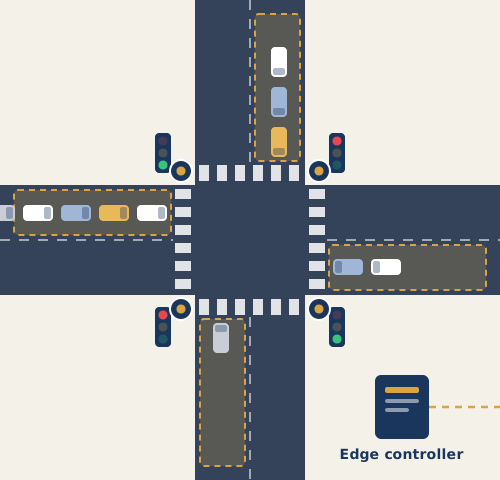
Fixed-time and manually-timed signals can't respond to how traffic actually behaves — a junction is jammed in one direction while another sits on an unnecessary red, an emergency vehicle gets stuck in the same queue as everyone else, and a stalled vehicle or pedestrian in the carriageway goes unnoticed until someone calls it in. Every one of those moments costs time, throughput, and in some cases, safety.
The Solution
Adaptive Signal Timing
Adjusts phase splits in real time based on vehicle density, queue length, and approach speed
Coordinated Corridor Control
Green-wave/platoon progression across multiple junctions, not isolated intersections
Automatic Incident Detection
Flags stalled vehicles, wrong-way movement, pedestrians on the carriageway, or debris — typically within seconds
Emergency Vehicle Priority
Automatic green corridor on detection of emergency vehicles
Pedestrian Phase Management
Crossing time optimized to actual pedestrian demand, not a fixed timer
Manual Override, Full Audit Trail
Traffic police can step in via the command dashboard anytime, with automatic resume to adaptive mode
Junction Performance Analytics
Delay index, throughput, and level-of-service scoring per junction — improvement is measurable, not assumed
How SignalSense works
System Components
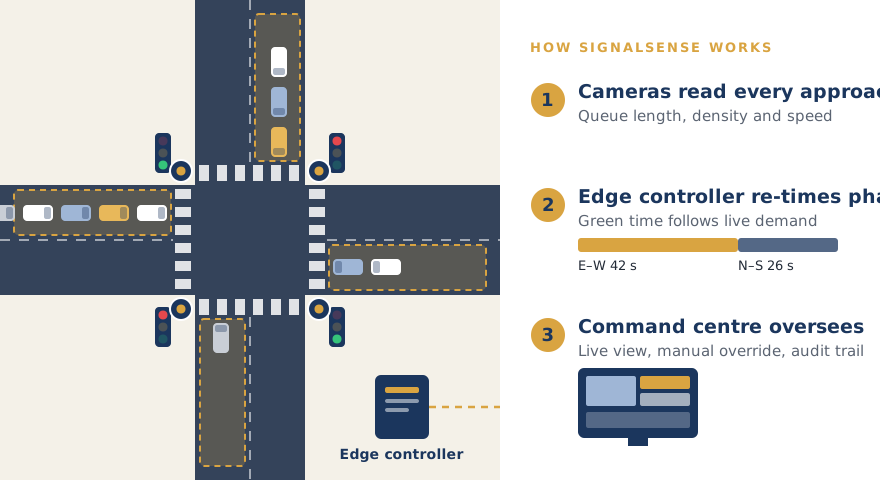
SignalSense brings detection, control and oversight together at every junction.
Vehicle detection
Cameras measure queues, density and speed on every approach.
Edge application
Runs the AI detection at the junction itself.
Master controller
Applies the timing plan to the signal heads.
LED signal heads
Standard signal lamps driven by the controller.
Countdown timers
Show drivers and pedestrians the time remaining.
Adaptive algorithm
Re-times phases continuously from live demand.
Web interface
Configure plans, view junctions and override from one screen.
Real-time reports
Delay, queue and throughput by junction and time of day.
Demand forecasting
Learns daily and weekly patterns to anticipate peaks.
API services
Share junction data with command centres and other systems.
Works with standard signal controllers and existing junction hardware — not a rip-and-replace system. Same DAIOS platform behind RuleSense and the rest of TrafficIQ, built for heterogeneous, lane-indisciplined traffic conditions.