
What Is a Traffic Management System?
1. Introduction
A Traffic Management System is an integrated technology platform designed to monitor control analyze and optimize traffic flow across urban roads highways intersections and corridors. It combines intelligent sensors cameras communication networks and software analytics to improve road safety reduce congestion and enhance overall transportation efficiency.
In modern Smart City and Highway ITMS projects Traffic Management Systems form the digital backbone for real time decision making automated enforcement and adaptive signal control.
2. What Is a Traffic Management System
A Traffic Management System refers to a centralized framework that collects traffic data processes it in real time and executes control strategies to manage vehicle movement pedestrian safety and incident response.
The system typically consists of:
-
Video based monitoring devices
-
Traffic sensors and detectors
-
Signal controllers
-
Communication networks
-
Central management software
It enables authorities to monitor traffic conditions detect violations manage incidents and dynamically regulate signals.
Explore Futops solutions for Traffic Management Systems:
https://futopstech.com/products/traffic-management-systems
3. Why Traffic Management Systems Are Important
Rapid urbanization increasing vehicle ownership and complex road networks make manual traffic control ineffective. A modern Traffic Management System delivers:
-
Reduced congestion and travel delays
-
Improved Road Safety
-
Faster incident detection and clearance
-
Higher enforcement compliance
-
Optimized signal coordination
-
Lower fuel consumption and emissions
These systems are essential building blocks of Smart City Mobility and national highway modernization programs.
4. Core Components of a Traffic Management System
4.1 Traffic Data Collection
Traffic data is collected using:
-
Video cameras
-
Radar and loop detectors
-
Automatic number plate recognition
-
AI based vehicle classification
This data forms the foundation of traffic intelligence and operational decision making.
4.2 Video Analytics and Incident Detection
Advanced analytics continuously monitor road activity to detect accidents stalled vehicles congestion and abnormal behavior.
Futops provides VIDES for automated incident monitoring on highways and urban corridors:
https://futopstech.com/products/traffic-management-systems/vides-video-incident-detection
4.3 Violation Detection and Enforcement
Automated enforcement improves discipline and reduces accident probability.
Key enforcement systems include:
-
RLVD – Red Light Violation Detection
https://futopstech.com/products/traffic-management-systems/rlvd-red-light-violation-detection -
SVDS – Speed Violation Detection
https://futopstech.com/products/traffic-management-systems/svds-speed-violation-detection
These solutions capture violations generate digital evidence and integrate with challan and prosecution systems.
4.4 Traffic Counting and Classification
Accurate traffic volume and vehicle composition data supports planning performance monitoring and infrastructure design.
Futops provides ATCC for continuous and survey based traffic counting:
https://futopstech.com/products/traffic-management-systems/atcc-traffic-counting-classification
For advanced survey analytics refer to Survey & Counting Systems:
https://futopstech.com/products/survey-counting-systems
4.5 Adaptive Signal Control
Adaptive signal control dynamically adjusts signal timings based on real time traffic demand improving corridor throughput and reducing stops.
Futops ATCS enables real time signal optimization across intersections:
https://futopstech.com/products/traffic-management-systems/atcs-adaptive-traffic-control-system
4.6 Pedestrian Safety Systems
Pedestrian focused systems improve safety at crossings school zones and transit hubs.
Futops APCS enhances pedestrian compliance and visibility:
https://futopstech.com/products/traffic-management-systems/apcs-pedestrian-crossing-system
5. Types of Traffic Management Systems
5.1 Urban Traffic Management System
Used in cities to manage:
-
Signalized intersections
-
Arterial corridors
-
Parking and curb management
-
Pedestrian movement
Integrated with Smart City Command Centers and mobility platforms.
5.2 Highway Traffic Management System
Designed for expressways and national highways focusing on:
-
Incident detection
-
Speed enforcement
-
Lane discipline
-
Tunnel and bridge monitoring
5.3 Integrated Traffic Management System
A unified platform combining:
-
Enforcement systems
-
Signal control
-
Incident management
-
Emergency coordination
-
City dashboards
6. Applications of Traffic Management Systems
Traffic Management Systems are deployed across:
-
Urban road networks
-
Smart City projects
-
National highways and expressways
-
Tunnels and bridges
-
Industrial and logistics corridors
-
Campuses and townships
They integrate with: -
Emergency response systems
-
Public transport systems
-
Surveillance platforms
-
City data exchanges
7. Benefits of Implementing a Traffic Management System
Major operational and societal benefits include:
-
Improved Traffic Flow
-
Reduced accident rates
-
Faster incident response
-
Higher compliance levels
-
Optimized infrastructure usage
-
Enhanced commuter experience
-
Data driven planning
8. Role of Traffic Surveys and Analytics
Traffic surveys are essential for informed planning, roadway design, forecasting and impact assessment.
Futops Traffic Pulse – Survey Intelligence transforms traffic data into actionable insights through advanced analytics.
https://futopstech.com/products/survey-counting-systems/traffic-pulse-survey-intelligence
Some other survey and Counting products are as:
-
People counting
https://futopstech.com/products/survey-counting-systems/traffic-pulse-people-counting -
Animal counting
https://futopstech.com/products/survey-counting-systems/traffic-pulse-animal-counting -
Object counting and classification
https://futopstech.com/products/survey-counting-systems/traffic-pulse-object-counting-classification
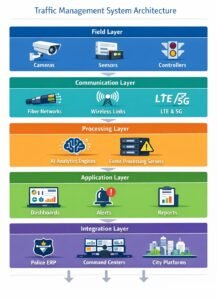
9. Traffic Management System Architecture
10. Future of Traffic Management Systems
Emerging trends include:
-
AI driven predictive congestion control
-
Vehicle to infrastructure communication
-
Autonomous vehicle integration
-
Cloud native traffic platforms
-
Digital twins for traffic simulation
Traffic Management Systems are evolving into intelligent mobility platforms forming the foundation of future transportation networks.
11. Conclusion
A Traffic Management System is a critical foundation for safe efficient and intelligent transportation infrastructure. By combining real time sensing automated enforcement adaptive control and advanced analytics it transforms conventional roads into smart mobility corridors.
Futops offers a comprehensive portfolio of Traffic Management Systems Survey Intelligence and Site Safety solutions tailored for Smart City and Highway ITMS projects.
Explore all Futops products:
https://futopstech.com/products