
Core Components of Modern Traffic Management Platforms
1. Introduction
Modern Traffic Management Platforms serve as the central digital infrastructure for managing complex urban and highway transportation networks.
They integrate sensing communication analytics enforcement control and visualization technologies into a unified operational ecosystem that supports real time decision making automated response and long term mobility planning.
In contemporary Smart City and Highway ITMS projects these platforms act as the operational backbone that connects field infrastructure with command centers and intelligent mobility services.
2. What Is a Traffic Management Platform
A Traffic Management Platform is a centralized and modular software driven system that coordinates the collection processing analysis and control of traffic data across multiple subsystems.
It integrates monitoring enforcement signal control incident management analytics and external agency systems through a unified command and control interface.
This platform functions as the core operational intelligence layer of modern Traffic Management Systems.
Explore Futops Traffic Management Systems portfolio:
https://futopstech.com/products/traffic-management-systems
3. Core Components of a Modern Traffic Management Platform
Modern platforms are built around a set of tightly integrated functional components. Each component plays a distinct operational role while working within a unified architecture.
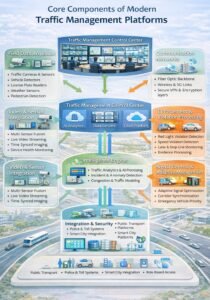
3.1 Field Data Acquisition Layer
This component captures real world traffic and environmental data from the road network.
It typically includes:
- Traffic cameras and video sensors
- Radar and loop vehicle detectors
- Automatic number plate recognition cameras
- Weather and environmental sensors
- Pedestrian and vulnerable road user detectors
This layer continuously generates traffic flow speed density violation and event data that feeds all higher level intelligence and control modules.
3.2 Communication and Network Infrastructure
This component provides reliable real time connectivity between field devices processing systems and control centers.
It includes:
- Optical fiber backbone networks
- Ethernet and IP based transport networks
- Wireless microwave and radio links
- LTE and 5G connectivity
- Secure VPN tunnels and encryption frameworks
This infrastructure ensures low latency data transfer high availability and secure system operation across distributed deployments.
3.3 Device Management and Sensor Integration
This component unifies heterogeneous sensing technologies into a common operational environment.
Core functions include:
- Centralized device configuration and monitoring
- Live video and sensor data streaming
- Multi camera synchronization
- Time aligned event recording
- Health diagnostics and fault management
Futops VIDES integrates video analytics for automated incident detection and monitoring:
https://futopstech.com/products/traffic-management-systems/vides-video-incident-detection
3.4 Analytics and Intelligence Engine
This component converts raw sensor data into actionable operational insights using advanced analytics and artificial intelligence.
It supports:
- Vehicle detection and classification
- Traffic volume and speed analytics
- Queue and congestion detection
- Incident and anomaly recognition
- Predictive traffic forecasting
Futops ATCC delivers continuous traffic counting and classification intelligence:
https://futopstech.com/products/traffic-management-systems/atcc-traffic-counting-classification
Advanced planning analytics are delivered through Survey & Counting Systems:
https://futopstech.com/products/survey-counting-systems
3.5 Enforcement and Violation Processing Module
This component enables large scale compliance monitoring and digital prosecution workflows.
It provides:
- Red light violation detection
- Speed violation detection
- Lane and stop line monitoring
- Automated evidence generation
- Violation validation and case management
- Integration with challan and court systems
Futops enforcement solutions include:
https://futopstech.com/products/traffic-management-systems/rlvd-red-light-violation-detection
https://futopstech.com/products/traffic-management-systems/svds-speed-violation-detection
3.6 Signal Control and Adaptive Management
This component regulates intersection operations and corridor coordination using fixed and adaptive strategies.
It supports:
- Fixed time and time of day plans
- Traffic responsive control
- Corridor synchronization
- Public transport and emergency priority
- Adaptive optimization based on live demand
Futops ATCS enables adaptive signal control across complex urban networks:
https://futopstech.com/products/traffic-management-systems/atcs-adaptive-traffic-control-system
3.7 Incident Management and Operational Response
This component manages the full lifecycle of traffic events and emergencies.
It provides:
- Automated incident detection
- Operator assisted verification
- Event classification and prioritization
- Dispatch and response coordination
- Clearance tracking and reporting
This component significantly reduces detection time response delay and secondary accident risk.
3.8 Traveler Information and Public Communication
This component delivers real time mobility information to road users and operators.
It supports:
- Variable message sign control
- Journey time estimation
- Route guidance and diversion advisories
- Mobile and web based traffic updates
- Public transport service information
This improves traveler awareness network utilization and overall system efficiency.
3.9 Data Management and Historical Analytics
This component stores and analyzes long term operational datasets for planning and performance evaluation.
It provides:
- Centralized data warehousing
- Time series traffic analytics
- Corridor and intersection performance metrics
- Demand forecasting models
- Strategic planning dashboards
Futops Traffic Pulse – Survey Intelligence enables advanced planning and forecasting:
https://futopstech.com/products/survey-counting-systems/traffic-pulse-survey-intelligence
3.10 Integration and Interoperability Layer
This component connects the traffic platform with external agencies and city systems.
It integrates with:
- Police and enforcement databases
- Emergency response systems
- Public transport control platforms
- Toll and parking systems
- Smart City command centers
This enables cross agency coordination unified governance and city wide mobility orchestration.
3.11 Control Center and Operator Interfaces
This component provides centralized operational supervision and strategic command.
It includes:
- Operator dashboards and consoles
- Video walls and situational displays
- Alarm and event management systems
- Decision support tools
- Performance monitoring and reporting
This interface forms the operational nerve center of the traffic management ecosystem.
3.12 Security and Reliability Framework
This component ensures continuous secure and resilient operation of the platform.
It provides:
- Role based access control
- Encrypted communication channels
- Redundant communication paths
- High availability server clusters
- Disaster recovery and backup systems
These measures protect critical transportation infrastructure and ensure uninterrupted service delivery.
4. Integration with Site Safety and Surveillance
Traffic platforms increasingly integrate with Site Safety systems for:
- Tunnel and bridge monitoring
- Construction zone supervision
- Logistics yard and warehouse safety
- Worker safety compliance
Futops Site Shield solutions enable intelligent safety operations:
https://futopstech.com/products/site-safety-surveillance
5. Benefits of a Modular Traffic Management Platform
Key operational benefits include:
- Improved Traffic Flow
- Reduced congestion and delays
- Faster incident response
- Higher enforcement compliance
- Optimized signal coordination
- Improved planning accuracy
- Scalable future expansion
These benefits directly support sustainable mobility and infrastructure efficiency.
6. Conclusion
The Core Components of Modern Traffic Management Platforms together form a sophisticated intelligent ecosystem that transforms traditional road networks into connected adaptive and data driven mobility systems. By clearly structuring sensing communication analytics enforcement and control as modular components authorities can design scalable interoperable and future ready transportation platforms.
Futops delivers comprehensive Traffic Management Platforms Survey Intelligence and Site Safety solutions designed for Smart City and Highway ITMS deployments.
Explore all Futops products:
https://futopstech.com/products