
Intelligent Transportation Systems (ITS)
1. Introduction
Intelligent Transportation Systems represent the application of advanced information communication sensing and automation technologies to improve the safety efficiency reliability and sustainability of transportation networks.
ITS integrates traffic management enforcement surveillance analytics and traveler information into a unified digital mobility ecosystem.
In modern Smart City and Highway ITMS projects ITS forms the technological foundation for real time traffic control automated enforcement and data driven mobility planning.
2. What Is Intelligent Transportation Systems
Intelligent Transportation Systems refer to a set of integrated hardware software communication and analytics technologies designed to collect process and act on transportation data in real time.
ITS enables authorities to monitor traffic conditions detect incidents enforce regulations manage signals and provide traveler information through centralized and distributed platforms.
It transforms conventional roads into intelligent connected and adaptive mobility corridors.
Explore Futops Traffic Management Systems portfolio:
https://futopstech.com/products/traffic-management-systems
3. Objectives of Intelligent Transportation Systems
The primary objectives of Intelligent Transportation Systems include:
-
Improving road safety and reducing accidents
-
Minimizing congestion and travel delays
-
Enhancing traffic flow efficiency
-
Supporting enforcement and compliance
-
Providing real time traveler information
-
Enabling data driven transport planning
-
Reducing fuel consumption and emissions
These objectives directly support Smart City Mobility and national transportation modernization programs.
4. Key Functional Areas of ITS
4.1 Traffic Monitoring and Control
ITS continuously monitors traffic conditions and dynamically regulates signals and corridors to maintain smooth flow.
Core functions include:
-
Signal coordination and timing optimization
-
Corridor and intersection management
-
Congestion detection and mitigation
Futops ATCS supports adaptive signal control in urban corridors:
https://futopstech.com/products/traffic-management-systems/atcs-adaptive-traffic-control-system
4.2 Incident Detection and Management
ITS detects accidents stalled vehicles wrong way driving and abnormal traffic behavior.
This enables rapid response coordination and faster clearance.
Futops VIDES provides automated incident detection on highways and urban roads:
https://futopstech.com/products/traffic-management-systems/vides-video-incident-detection
4.3 Enforcement and Compliance
ITS automates traffic law enforcement to improve discipline and reduce violations.
Key enforcement applications include:
-
Red light violation detection
-
Speed violation detection
-
Lane and stop line monitoring
Futops enforcement solutions include:
https://futopstech.com/products/traffic-management-systems/rlvd-red-light-violation-detection
https://futopstech.com/products/traffic-management-systems/svds-speed-violation-detection
4.4 Traffic Data Collection and Analytics
ITS captures continuous traffic volume speed and classification data to support planning and performance analysis.
Futops ATCC enables accurate traffic counting and classification:
https://futopstech.com/products/traffic-management-systems/atcc-traffic-counting-classification
Advanced survey analytics are provided through Survey & Counting Systems:
https://futopstech.com/products/survey-counting-systems
4.5 Pedestrian and Vulnerable Road User Safety
ITS improves safety at crossings school zones and transit hubs through intelligent detection and warning systems.
Futops APCS enhances pedestrian crossing safety and compliance:
https://futopstech.com/products/traffic-management-systems/apcs-pedestrian-crossing-system
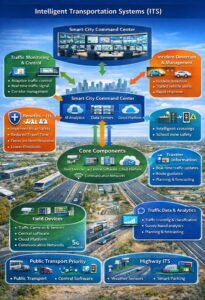
5. Core Components of Intelligent Transportation Systems
An ITS deployment typically consists of:
Field devices
-
Traffic cameras and sensors
-
Vehicle detectors and radars
-
Signal controllers
-
Variable message signs
-
Environmental sensors
Communication infrastructure
-
Fiber optic networks
-
Ethernet and IP networks
-
Wireless links
-
LTE and 5G communication
Central systems
-
Video management servers
-
Analytics engines
-
Databases
-
Control software
Control centers
-
Operator workstations
-
Video walls
-
Decision support tools
These components operate together to deliver real time situational awareness and coordinated control.
6. ITS Architecture Overview
Intelligent Transportation Systems follow a layered architecture consisting of:
-
Field layer for data acquisition and local control
-
Communication layer for data transmission
-
Processing layer for analytics and event detection
-
Application layer for monitoring and operations
-
Integration layer for cross agency coordination
This architecture ensures scalability interoperability and long term system sustainability.
7. Applications of Intelligent Transportation Systems
ITS is deployed across a wide range of transportation environments including:
-
Urban road networks
-
Smart City corridors
-
National highways and expressways
-
Tunnels and bridges
-
Industrial and logistics zones
-
Campuses and townships
Common ITS applications include:
-
Adaptive traffic control
-
Automated enforcement
-
Incident management
-
Traveler information systems
-
Parking management
-
Public transport priority
8. Integration with Smart Cities and Mobility Platforms
In Smart City projects ITS integrates with:
-
City command and control centers
-
Urban surveillance platforms
-
Emergency management systems
-
Environmental monitoring systems
-
Public transport operations
For highways and expressways it integrates with:
-
Highway patrol systems
-
Toll management platforms
-
Tunnel control systems
-
Weather monitoring networks
Futops solutions across Traffic Management Systems and Site Safety platforms support integrated mobility ecosystems:
https://futopstech.com/products/site-safety-surveillance
9. Benefits of Implementing Intelligent Transportation Systems
Key benefits delivered by Intelligent Transportation Systems include:
-
Improved Road Safety
-
Reduced congestion and travel time
-
Faster incident detection and response
-
Higher enforcement compliance
-
Optimized infrastructure utilization
-
Enhanced commuter experience
-
Better planning and forecasting accuracy
These benefits contribute directly to sustainable urban mobility and economic productivity.
10. Future of Intelligent Transportation Systems
The evolution of ITS is driven by:
-
Artificial intelligence based traffic prediction
-
Vehicle to infrastructure communication
-
Connected and autonomous vehicles
-
Cloud native traffic platforms
-
Digital twins and simulation models
Future ITS platforms will become fully adaptive self learning and mobility centric.
11. Conclusion
Intelligent Transportation Systems form the technological backbone of modern transportation networks. By integrating sensing communication analytics and control they enable safer more efficient and more sustainable mobility across cities and highways.
Futops delivers comprehensive ITS aligned Traffic Management Systems Survey Intelligence and Site Safety platforms designed for Smart City and Highway ITMS deployments.
Explore all Futops products:
https://futopstech.com/products